The Selectboard's Need for Control
What Is Going On?
On August 13th, the Selectboard took up two articles to put on a Special Town Meeting ballot for September 24th, 2026. They read as follows
Article 1. Shall the Town voters authorize total expenditures of $491,024 for Kimball Public Library expenses for fiscal year 2027, of which $401,956 would be raised by taxes and an estimated $89,068 would come from non-tax revenue?
Article 2. Shall the Town voters authorize an additional $38,116 for Kimball Public Library expenses for the fiscal year beginning July 1, 2026, and ending June 30, 2027, thereby increasing total authorized expenditures from $491,024 to $529,140? The additional $38,116 would be raised by taxes, with no additional amount coming from non-tax revenue
What the fuck is actually going on?
Some Background
If you want a more comprehensive overview of how this mess started please refer to my previous post and feel free to jump to the next section.
After the voters voted down the Kimball Public Library’s budget in March 2026 many of us demanded that the Selectboard simply allow us to vote on the budget proposed by the library’s Board of Trustees. This was for a few reasons, one being that we elect the Board of Trustees to manage the library and make the best decisions for that library, and we’d prefer to make the determination on whether the budget they proposed was too high or not. The Selectboard declined to allow that, instead making their own budget to be voted on at a Special Town Meeting on June 29th.
The budget on the 29th was voted down, again. If you peruse the local paper or Front Porch Forum you’ll see many many people asked for the budget to be voted down to let the Selectboard know that the voters of this town would prefer them to stop standing in the way of our democracy, and to allow us to simply vote on the budget from the Board of Trustees. There were one or two lone voices asking people to vote down the budget for other reasons.
In an effort to remove the Selectboard from the budgeting process and to give the power directly to the voters, a petition was created that called for a vote on the Board of Trustees’ budget to be held concurrently with the general election on November 3rd. This would allow us to vote on the proposed budget and not cost thousands of dollars like a standalone Special Town Meeting does. This petition received 248 signatures from voters of this town, which is 6.5% of all registered voters and 30% greater than a petition needs.
So What Happened With the Petition
When the petition was submitted to the Selectboard – with signatures from 1 out of every 15 persons in town – the Selectboard decided to fully ignore it. The Selectboard claims that the petition was “advisory” and that they did not need to adhere to it. This claim is dubious to me. For one thing, I spoke with the Elections Division of the Secretary of State's office and they stated specifically that petitions are binding for anything that State Law specifically says residents are able to vote on. They even specifically said petitions regarding the General Fund and the Town’s Highway Department Fund would be binding (keep that in mind my libertarian friends). Now, municipal libraries are, in fact, specifically laid out in statute as something we have the power to vote on, therefore the petition should be binding according to the Secretary of State.
I will be fair and note that past case law has pointed out that if there is a specified process for reviewing budget votes then the Selectboard’s decision to follow that process and ignore a petition is valid. However, I can’t find in statute anywhere where municipal libraries have such a specific procedure. The Selectboard seems to think the process that governs the General Fund applies to the library, but I’d argue that is being misconstrued.
Of course, I am not a lawyer, and neither are most of the Selectboard. In fact, the only lawyer on the Selectboard has recused himself from discussions on the library due to his wife working for Kimball. And any lawyer the town receives advice from would be more than happy to zealously defend whatever position the town wishes to take (if lawyers' opinions were completely objective then we’d never see them fighting in the court room). As I have stated previously, the only way to get concrete answers here is to utilize our court system to have these questions answered, but most people are unwilling to sue the town over matters such as these.
So, with the petition being denied and the wishes of the voters who signed the petition being cast aside, we are left with those two confusing articles I put at the top of this post. But I don’t want to spend any more time litigating this library matter. Instead I think this specific issue encapsulates the entirety of the problem with our current Selectboard: their insistent need to be in control.
The Selectboard’s Need for Control
The Selectboard has displayed a worrying pattern of making decisions and expressing opinions that are not in the best interests of the town, but are in the interest of retaining control and power. This is readily apparent to anyone who pays attention to what they do month-to-month. Indeed, they rely on the fact that many people in town do not have the time to pay attention to their every action. Instead, the majority of us put trust and faith into our elected officials.
I would like to go through a few examples of how the Selectboard has done this in the near past and make the argument that, if you analyze their decisions with control and power in mind, all of their decisions, like them or not, become exceedingly rational and easy to predict.
Before we get into the analyses I’d like to introduce something I read recently and have been thinking about a lot:
The people who control institutions care first and foremost about their power within the institution rather than the power of the institution itself. Thus, they would rather the institution “fail” while they remain in power within the institution than for the institution to “succeed” if that requires them to lose power within the institution.
This quote, from Jon Schwartz, has been aptly named The Iron Law of Institutions. I think this provides a good framework for how to view the decisions made by governments both big and small.
In our case the “institution” is the town and its government. The “power of the institution” is its ability to do productive work for the community and its residents. The institution “fails” when the overall health of the town worsens due to their decisions and actions or inactions.
Some Examples
The AI Permitting Software
Back in April the Selectboard had an agenda item titled: “Consider Authorizing the Award of a Permitting Software Contract.” If you went through the agenda’s packet you’d see that the permitting software being proposed was from a company called Polimorphic, and would cost the town a total of around $9,000 a year. Further, if you went to Polimorphic’s Website you’d see a lot of hoopla regarding AI on their site. As of the date of posting, the main heading on their site is, in fact, “The Complete AI Platform for Government Services.”
This of course raised a number of questions upon review. The first that came to mind was, “What’s their privacy policy?” since they are clearly a cloud-based business and anyone who uses their service will be handing over data. The second was, “What AI company are they using on their backend, or have the developed their own?” and, similarly, “What data do they share with that AI company and how much of their platform is in fact AI?” These questions, I believe, are reasonable base-line questions that should have been asked. But, unfortunately, the Selectboard was willing to forgo any of these questions themselves. There was actually a motion made, with a second, to approve the software without any discussion of the previous questions or any question at all.
After some pushback from the public the Selectboard decided to move a decision on the matter back by a month. When the next meeting came around we had some answers to those questions from our Zoning Director, who had passed them onto Polimorphic. However, notably, nobody on the Selectboard ever reviewed the privacy policy from Polimorphic. Polimorphic insisted that their public privacy policy was not the sketchy one they have on their website, but it was not passed along to the Selectboard. Every single member of the public at that meeting spoke out to let the Selectboard know that they’d prefer to not have the town enter into a contract with Polimorphic. It was noted as well that the stated savings of going to a part-time, contracted Zoning Administrator over having a full-time one was around $10-11,000 a year, but with this software those savings are down to $2,000 and we only have a Zoning Administrator in office 2 days as well.
After much discussion the decision was made to go along with the software because the Selectboard wants to limit getting into the “nitty gritty details” and “trust our staff to make good choices”
On one hand, it’s nice to know that our board puts its faith in its employees, but, on the other hand, it’s scary to think that they go into contracts without knowing the full details of them. I find their decision on this inane for two main reasons: one being that, as was stated in the first meeting, most people don’t read privacy policies on the websites they use. Therefore, the burden should be on the Selectboard to ensure that they thoroughly review any policy which will affect users of their tool. Secondly, the “staff” in this case is actually a vendor we contract with. We contract with ReThink Local at approximately $70,000 a year for Alex Torpey, its owner, to work two days a week to do the work of a fulltime Zoning Administrator. I don’t think it is unreasonable to point out that Alex has a vested interested in making his job as easy as possible so that he can adequately do it the two days a week he works, and I don’t think it’s unreasonable to believe he would put his company, and his profits, above the interests of the residents of this town, especially if we’re footing the bill for him. In fact, he can be pictured here at a conference last year chumming it up with the CEO of Polimorphic itself. Not a great look for an objective choice.
In this case the town decided to retain its control and move forward with software that members of the public clearly did not approve of. They decided that the contractor that they picked knew better than the people who live and pay taxes in this district. This is rational from their point-of-view, because if their overpaid contractor is making poor decisions, then that means they made a poor decision by going forward to contract with him in the first place.
Selectboard Appointments
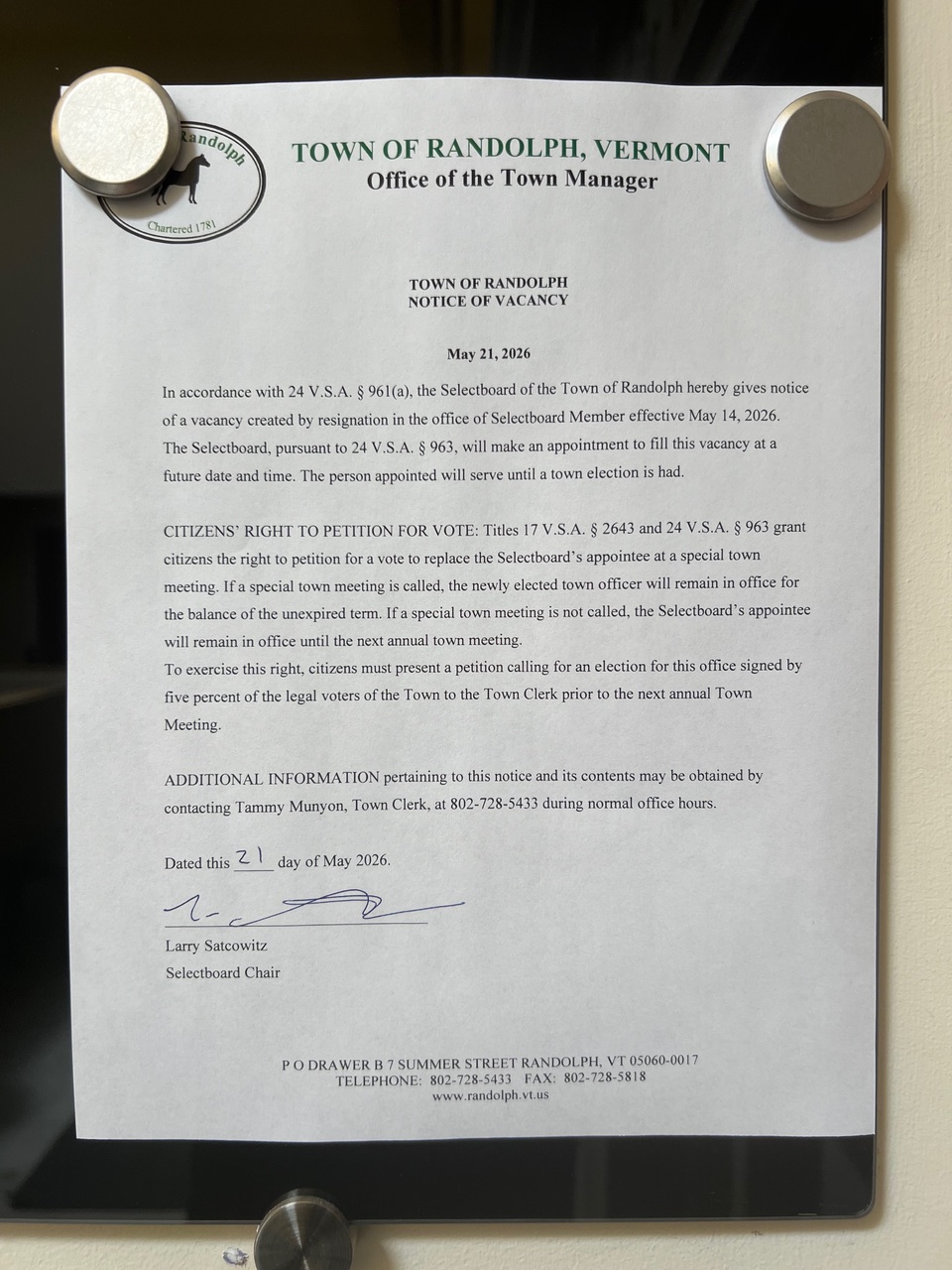
As some of you may know we recently got a new member of the Selectboard. John Moniz was appointed to the Selectboard in July of this year, after a member of the board resigned back in May. Selectboard members being appointed to fill vacant positions occurs every few years, usually to little fanfare. I mean, why would there be fanfare anyways? This is a standard process, done according to statute, and probably has little impact on the way the board operates, right?
The thing is though, this doesn’t have to be the standard process, statute offers alternative solutions to appointments, and it has a major impact on how the board operates as a whole.
Let’s start with the appointment process in general. While state law provides that the Selectboard is allowed to appoint members to fill vacancies, they don’t mandate it. In fact, we are allowed to petition for a Special Town Meeting to fill that vacancy, or to do any other matter of business we have a right to vote on to begin with. This is something that Larry, the current chair of the board, publicly acknowledged. Moreover, anything we can petition to have a Special Town Meeting on, the Selectboard can just schedule a Special Town Meeting for. But, they never do this.
On one hand, that makes some sense. They want the position filled as soon as possible so they can work effectively, and they don’t want to waste town money on an election. However, this is grossly anti-democratic in its nature, and in this instance makes zero sense to begin with. Take, for example, John’s appointment. That seat was open starting before they warned a Special Town Meeting to vote on the library’s budget. This means they had the ability to simply add an extra article onto that meeting, which we were already going to spend money on, to let us vote on who should fill the vacancy.
Instead, they choose to make sure that they were able to choose a person of their liking to fill the role, regardless of what the public may want. It’s extra obvious they did this simply to maintain a board makeup amenable to them given that the position would have been filled sooner if this was on that ballot.
Now, how does this affect the makeup of the board in the long run, and is it that bad? Well, if we look at John as an example, I think it’s obvious to anyone who watched the meeting that there were better candidates. This is in no way an attack on John, but go back and watch the meeting yourself and see if you’d pick John over Sonnie Irons, Scott Berkey, Alejandro Ruiz, Ken Hafner, or Tom Harty. They all either have more experience, time, or knowledge of the inner workings of town government than he did, by a large margin. I believe wholeheartedly he was only picked due to his alignment with the current Chief of Police and likely some friendships, or associations, with other board members that are not in the public sphere.
It’s understandable that some of you may not see the big deal with this process still. The appointments save public political discourse in the “off-season” and these people can be voted out later if need be. But, the problem with that assumption is that it denies the realities of incumbency advantage. It has been long known that people already holding an office are more likely to win their next election. Once appointed these members will have an article written about them, will appear in general news about the Selectboard, and will, in general, just have an easier time building-up name recognition before they’re up for election.
With all of this in mind I think these appointments are a perfect example of the Selectboard acting in a way solely designed to concentrate their power. They do not give us the option to choose our representative, they choose representatives in alignment with their own goals, and then they use the very power of the office itself to increase the odds their pick wins the next election. This is, afterall, the same process that gave us Trini Brassard.
The Killing of Public Buildings
In an effort to retain their control over the town, and to utilize the power of town government to only benefit their associates, the Selectboard has repeatedly made decisions that directly harm public meeting spaces in Randolph.
There are multiple examples of this, such as the East Valley Community Hall in East Randolph that was supposed to be a community space as well as offices for the East Randolph Fire Department, but is now a slowly crumbling building. The main example of this behavior recently, however, is the Library’s Cupola grant shenanigans that have been ongoing over the past few years.
If you want an actually pretty good primer on the cupola saga, the March Selectboard meeting is worth a watch. Other than that, the key details are as follows: the historic Kimball Public Library’s cupola started leaking around 2015; after that the library’s Board of Trustees sought funding to fix it; after further issues with the cupola, the library asked the town to help address the issue, as it’s a town building; after much inaction from the town the library sought a grant from the VHCB; they were awarded the grant, pending approval from the Selectboard; and the Selectboard has refused to accept the grant.
There are other important details, but, again, the key issue at present is the VHCB grant. The reasoning the Selectboard has given for not accepting this money is that the grant imposes a perpetual easement on the property, which mandates that the town maintains the building in a historic manner. They believe that this is an overreach and have argued that it is not in the best interest of the town. Why not? Well, their reasoning has been a bit all over the place. I’d argue their unstated reason is that they want full control of the library, regardless of if it’s at risk of future catastrophic damage or if it will become more expensive to repair due to their inaction.
Of course, their go-to argument is that the library should fundraise and build-out a robust donor base to support the maintenance of this public building. This idea is silly for a few reasons. One being that the library is a municipal library. It’s paid for by the people, owned by the people, has a board elected by the people, and has a duty to provide services in the best interest of the residents here in town. Relying on money from the wealthy in town is a direct contradiction to the concept of a municipal library. Rich people don’t want to donate to a library that spends their money on a Library of Things, where you can rent useful items that otherwise you may be unable to afford. Rich people also don’t want to have a library that houses books that promote alternative visions of the world to the one they have. They’d prefer a library that acts more like Chandler, which promotes its wealthy donors and even lets them buy advertising space on their website and elsewhere. I mean, who wouldn’t want a library that hocks ads for that tacky hotel by the highway?!
The second reason the fundraising idea is silly is that it contradicts their logic elsewhere. When we talk about the library’s budget they want to have the final say, and want to reduce the power of the library’s Board of Trustees, but, suddenly, when there is a building problem it’s wholly the problem of the library and the library board. They want to control the library’s funding and where it comes from; treat the library like a town department, instead of a separate entity by statute; and yet are unwilling to foot the bill when this town owned building has a structural issue.
One last thing I’d like to point out regarding this. In 2009 Chandler Music Hall was trying to raise funds for its Centennial Project. Many people I’ve heard talk about this have pointed out that it was a massive fundraising operation and used that to say the library could undergo a similar capital campaign. Here’s the thing though: $750,000 came from a bond the Selectboard accepted that we’re still paying off to this day. This was in addition to multiple other grants, awards, and private donations. Notably, they turned down a similar grant to the library’s with a historic preservation easement, which means we could have saved tax payers $100,000 plus interest had we taken that. They’re happy to go into debt and spend tax payer money to renovate a building that brings tourists into town, but, regardless of the building, they are unwilling to simply sign an agreement they perceive as giving up the smallest amount of control.
Those With Power Vs. Those Without
Those examples are a non-exhaustive list used to show how town government makes decisions in open and public meetings, with a decent amount of public input; and how they still find ways to dismiss the will of the people in those meetings. But, there are still driving forces and opportunities for control that those in power wield outside of the public eye. These are only afforded to those in power, and only go towards strengthening their grip on our small town. To demonstrate this point, let us look at the previous and current chairs of the Selectboard.
There’s Something About Trini Brassard
Trini Brassard was first appointed to the Selectboard back in 2012. From there she did her work as a Selectboard member diligently and gained experience and seniority until she was appointed to be the chair in 2016. After that she was notorious for running a tight ship. She kept debate with the public limited, she chose which topics the board took-up each month, she had the first and last say on any issue, she worked closely with our town managers, and she made sure the rest of the Selectboard fell in line. And oh boy did she do that last one. In the last five years of her time on the Selectboard there were only two non-unanimous votes that I could find. That’s insane, no board should agree with each other that much on anything, even if everything that came up had been mundane, statute governed municipal matters.
However, Trini has benefited from the power of the institution and from the control it exerts in ways that the average person could not dream of. I think the best demonstration of this is the current civil suit that has been filed against her. In fact, I think this lawsuit against Trini, and how it has been wholly ignored by the powers that be in town, is emblematic of the larger issues with our current Selectboard and even society in general.
Before I discuss this lawsuit any further I want to put up this disclaimer:
Trini Brassard, and her co-defendants, are being sued civilly. At present, they have not been found guilty in this trial, and, even if they are, a guilty verdict in a civil case does not mean that any crimes have been committed.
Great, with that out of the way, let’s get into the details.
The Allegations Against Trini Brassard
In July of 2023, Trini Brassard, Courtney Brassard, Brian Falzo and Brassard Sugarworks and Maple Supply, LLC (owned and operated by Daniel Brassard) were sued by John Durkee. John Durkee is the State appointed executor of the estate of Kenneth H. Blaisdell, Trini’s late father. The complaint against the defendants accuse Trini of embezzlement, breach of fiduciary duty, conversion, and fraud, among other charges.
The just of this case, in layman's terms, is that the executor of Trini’s father’s estate believes that, in the years leading up to his death, she was using her status a his Power of Attorney to unjustly enrich herself, her family, and their businesses. There are many claims in there that, if true, warrant much scrutiny and review on how Trini was operating while she was the chair of the Selectboard. There are also claims in here that she has admitted to which, even if they aren’t crimes, show the ways in which the wealthy are able to propagate their wealth in ways the rest of us never could.
For example, in 2015 Trini evicted two tenants on her father’s land. These tenants owned the mobile home on the land, but rented the land itself. After a few months of them missing their rent, Trini used her authority to evict these tenants. In the eviction notice she specifically noted how difficult it is to move a mobile home and generously offered to “negotiate” to buy it from them. I find evicting people who own the home on your land, but not the land itself, quite grotesque, but it’s not a crime or that unusual. The unusual part is the reason why she went forward with evicting them. She claims it was to “...implement some of the things that were spelled out by our father.”
What were these alleged plans from her father? Apparently to give Daniel Brassard, her son, a 15 year rent free lease on the land. Later that month he also got a 20 year rent-free lease for land to use for his sugaring business. None of this is criminal on its own, and, again, I can’t testify to whether any of this is criminal at all. But, I will note the great power she had at her fingertips and the willingness she demonstrated to use it. She willfully used it to displace people to help her son establish his business and get to live out his dream as an entrepreneur, so much for living in a meritocracy.
Now, there are a lot of details we could get into with this case, but they aren’t exactly relevant to the point I’m going to make. If you are interested in reading the complaint yourself, or viewing all documents related to the case as of April of this year, we have made them available to the public.
Why This Matters
Regardless of Trini’s guilt, the fact that she was accused of embezzlement and fraud should have not only been big news in town, but should have made it impossible for her to remain chair of the Selectboard. Instead, it was kept quiet by herself and those who knew of these allegations around her. If the other Selectboard members knew of this, and I would gather that at least a few of them had to, they never mentioned it publicly and voted her to continue as chair for two more years after this. To this day Trini is still actively working to “see through a few projects” for the town.
Of course, those Selectboard members would point out, and rightfully so, that she hadn’t been found guilty of anything and therefore we should presume her innocent. That ignores, however, the fact that it is standard operating procedure to demote, suspend, or otherwise reduce the unaccounted power of people accused of the types of crimes that put small towns most at risk. At least, that’s the standard operating procedure if these accusations come to light. Instead of taking any actions, or even acknowledging this publicly, the institution retained its power within itself at the potential detriment to the town. Trini continued to be chair, and continued being the main contact between the Selectboard, its members in between meetings, the Town Manager, the police chief, and the other high ranking officials in town that answer to the Selectboard itself. All the while the nature of power itself ensured that these allegations didn’t come to light while Trini was on the board.
The control that the Selectboard has extends beyond anything explicitly stated or done. For example, you’d think that The Herald would have reported on this in some way, but that didn’t happen. Why not? Well, it’s because The Herald fears reporting on these allegations. They are regarding someone who holds not only great wealth, but the ultimate power within town. The Herald is not some regional enterprise that can afford to fight with the powerful here in town, it is a humble local paper who makes money selling subscriptions to the residents of the White River Valley, and from selling papers to the same local businesses who are too often intimately connected with town government. The Herald knew of these accusations all the way back in August of 2023, and they were approached a few months ago regarding this issue from a town resident.
The fact that our local paper is unwilling to report on allegations against a sitting Selectboard member is troubling but predictable. They’re more than happy to report on allegations against everyday folks in town, because those people don’t threaten their business and livelihood. If you’re charged with a crime, but, like Trini, not yet found guilty, The Herald will happily write an article about it. Hell, if you’re accused of embezzlement they’ll write about it, just as long as you don’t pose a threat to them. It’s unfortunate that this is the case, and yet it’s the same in many other places. Those in power have the ability to make the lives of perceived enemies hard, and independent media organizations are prime targets if they aren’t careful.
Larry Satcowitz and the Voice of the People
Trini Brassard may have been a long standing chair of the Selectboard, who had close ties to the business community, and wielded the power of the Selectboard to ensure dissent did not happen anywhere within town government. However, Trini is no longer formally in power, and the prior examples of the Selectboard choosing power over the community were all overseen by the current chair, Larry Satcowitz.
A Champion of democracy
If you took a look through Larry’s legislation page on his campaign site for State Representative, you’d think, at a glance, that he’s a real mover and shaker. Someone willing to stand up to the powerful and fight for the little guy. He wants to tax the rich, fix abandoned housing, ban data centers, improve our environment, and create our very own Vermont Citizen’s Assembly. So how come none of us have heard of these things before campaign season, and why does it feel like his zealous energy to champion democracy is nowhere to be seen in his work on the Selectboard?
Well, it’s because all of this is for show, and Larry will happily appeal to his left flank when running for office, but will be obedient to the institution when actually in office. Many of the bills he touts when running have never made it past a first reading, i.e. no one who supported those bills is actually fighting hard enough to have them go through the legislative process. And some of these bills don’t even appear to have been drafted for anything other than using them for political points later on.
Take, for example, his Citizen’s Assembly bill which he describes as, “…the most important legislation I’ve been working on…” The idea of a Citizen’s Assembly is a bold one. One in which the governing body, and the institution (the legislature in this case), cede some of their power directly to everyday citizens. Larry’s bill, however, wouldn’t really do all that much if it ever were passed. It’d select one hundred and fifty people each year, have them work on the weekends for a few months, force them to focus on a single issue that was decided by the previous assembly, and merely let them make “recommendations” to the General Assembly. It is, quite frankly, just a large, bureaucratic advisory board with no real power and no ability to compel the legislature to abide by the people’s will.
An Anti-Democratic Bureaucrat.
This watered down concept of a Citizen’s Assembly being Larry’s most important piece of legislation fits perfectly within the idea that institutions only wish to keep power within themselves. They pretend as if they would like to empower the masses and make radical changes, but these promises end up being farces which we fall for repeatedly. Larry has no intent of handing any legislative power over to the people, just like he has no intent on handing any Selectboard power over to the people. We’ve seen how he treats advisory boards here in town. If they’re ones that say things that go with his world view, or that more fully empower the institution, then he’s all on board. Otherwise, he hears their advice and ignores them wholeheartedly.
This brings us back to the library budget issue at hand. What I didn’t include in the background at the beginning of this article was the fact that the Budget Committee of Randolph, an advisory committee filled with democratically elected officials as opposed to appointed ones, recommended the Selectboard simply adopt the library Board of Trustees’ proposed budget for the special meeting back in July. That way the people would be able to vote on the budget, and if it was voted down then it’d be obvious why it was voted down. Instead of listening to them, Larry allowed us to be dragged into the mess we’re in now, and has set up this unreasonably complicated vote for next month where, no matter the outcome, he wins. If the budget is voted down, then the Selectboard can say they were right to be skeptical of increasing the library’s budget from the beginning; if the budget is approved, but the second article is voted down, then they can claim the people really liked their budget and not the ask from the Board of Trustees; and if both articles pass then that’s good for them too, because they had the great idea to have these two articles which allowed the people to make their decision obvious, alas, democracy in action.
This type of bureaucracy is typical of liberals who want to feign as if they really would like people to have power, but actually wish to retain it themselves. Larry believes civil discourse along with the slow progress of time are more important than actually allowing people direct democracy. And maybe he’s right, I mean, don't you remember that a citizen jury decided to execute Socrates for asking philosophical questions? Perhaps letting the best, and most civil, amongst us make all the important decisions is the right move.
Larry Is Not Like you
I say all this to lay out this fact: Larry is not like you and doesn’t share the same set of values you do. Neither are most of the current members of the Selectboard, or any in recent history. Let’s look at the current chair as an example because the buck stops with him as far as town matters are concerned.
Larry owns approximately $2,500,000 worth of property in town. That’s $2,500,000 based on the assessed values of his eight properties, which means the actual value of his property holdings is likely much higher. You do not own that much property, and neither do I, and neither of us ever will. On top of that, best I can figure, the bulk of his income is from the rent he charges his tenants. Perhaps he’s benevolent, and charges them the bare minimum. Maybe he suffices primarily on his wife’s income and the meager wages he makes as a State Representative. I doubt this very much though, as I don’t see how either of those would be able to allow him to continue amassing property to the tune of $2,500,000 worth of it, and if I’m wrong I’d love for him to come out publicly with how much he makes from his rentals.
As a landlord with many properties that help sustain his lifestyle, he has an incentive to charge his tenants as much as is necessary to live the way he wants to live. He may be the nicest guy in the world (and he is very nice indeed), yet even if he only charges them an amount to allow him to live an “average” life then he’s still charging them a fair chunk more than the cost to maintain his properties. Additionally, unlike his tenants, if he ever fell on hard times he could offload his properties for hard-cash and a substantial gain on his investments. In this way Larry is removed from the rest of us in his view of how the world works, and what struggling looks like.
His massive wealth, and landlordism, shape his worldview whether he likes it or not. This is probably why he’s very happy to raise income taxes on the wealthy, but silent on raising property taxes for them. Or why he’s the sole sponsor of a bill that would allow municipalities to tax "derelict" properties. If that one passed he could use the institutional power of the Selectboard to force poor people who can’t fix their homes to put them on the market or put them up for tax sale, where he could gain more wealth on the cheap. I’m not saying he would do that, or plans to, but this bill certainly doesn’t hurt his prospects for accumulating more of the housing stock here in town.
Larry Satcowitz may be a nice man, he may be well educated and a good advocate for environmental protections, and he may be amendable to the general concept of allowing people to have more say in their government. In practice though, he’s just another rich man with power who cannot see past the walls of the institutions he holds power in, and he can’t be a true advocate for you or I without a reckoning from the people.
This Is Not Going Away Without Work
I’d love to say that these anecdotes are just that, anecdotes, they unfortunately aren’t and are part of a pattern. It’d also be great to say that Trini or Larry, and the way they uphold the institution of town and use it to benefit themselves, are unique, but they’re not. Furthermore, it’d be great if I could also tell you that this is very specific to Randolph and with a bit of voting and education we could fix all of this. That isn’t true either. Randolph is one town out of many many others where the institution that runs the town is more focused on retaining that control than in improving the lives of the residents of the town.
We Need to Come Together
Usually when someone says that we need to come together they’re mostly trying to tell you that we all need to be nice to each other and get along. I’m not here to say that. What is more important than getting along and being civil is actually being able to collectively come together and determine our futures. For the last time, lets go back to the damn library budget: I don’t care if you actually want to pay for the Board of Trustee’s budget or not. I really don’t. I support their budget, but I’m not writing this entire article because it’s that important to me. What I care about is that you, me, and the rest of the town are able to vote on the thing. Up or down, it makes less of a difference to me than the fact that we can determine it. We elect the Board of Trustees, and if we don’t like how they’re operating we can remove them, but municipal libraries are designed to operate independent of the governing body of a town so that they can’t be censored. If we let the governing body of the town determine the budget that we get to vote on, then we might as well censor them. Or better yet, let them get more funding from rich donors in town, that way the same people on the Selectboard, and their friends, can own and control the library even more.
We need to come together as a town to mandate that the institution relinquish its power and give it to us, as a whole. We won’t always like the decisions that the majority in town make, but at least they made it without strings attached or to uphold any perverse structure. We already have a fairly strong system for coming together and making decisions compared with most other states in our union, but we’re losing it slowly every year. At every Town Meeting now the Selectboard makes an ask to fully get rid of in-person Town Meeting, the one day we have a legal right to gather in a room, have public debate, and vote on things without the need for representatives. They claim it’s because turn out is low, and it’s unfair to those who don’t show up. But, they neglect to mention that they fully control how many people show up. You won’t ever get 100% of people to show up, but the institution in town had the direct ability to promote Town Meeting and increase participation. They could send reminders, or mail out Town Reports (something they used to do), or advertise free rides (a thing we have, they just don’t let anyone know). Instead, they’d rather remove this last beacon of in-person communal democracy.
Our Governance Structure Needs to Change
Ok, so we can all get loud and say we want change, but what does that do? Not much really. Our best tool currently is the electoral process, which can be useful in the short term, and rarely works out in the long term. If we replaced the entire Selectboard overnight with the working class, proponents of small government, the politically dejected, and the poor, who want to fully de-bureaucratize and democratize town government, it would only last so long. We live in a town with rules, and those rules say we need elected officials to manage everything.
Unfortunately, long-term change requires the work to both create a new system (by charter in this case) and to manage that system. And what new system would work best for town? Should we remove the Selectboard and keep only a Town Manager? Should we remove the Selectboard and Town Manager and try to create a better version of Larry’s Citizen’s Assembly? How much power do we give to the people? All of it, and if so do we have to meet every month to sign accounts payable receipts? Some of it, and risk the institution building back up its power over time?
I do not have the answers, and I’m sure some of you think the current system is as good as it can get. To you, I'll point out that the current system is the one that has created every issue, big or small, that you’ve ever had with this town. You may think that’s just the way things are, and nothing will ever be perfect. That’s fine, but I choose to believe that, while things can’t be perfect, they can certainly be better.
I encourage you to think of ways in which the system could be better. Talk with your friends and neighbors about it. Contemplate what a better system may look like. Read books about alternative systems and write about them in long, rambling articles on a website that few people will ever read. I’m doing all of those things myself because I love this town and I want to see it succeed going into the future.
Dustin Adams